
Context
The brief.
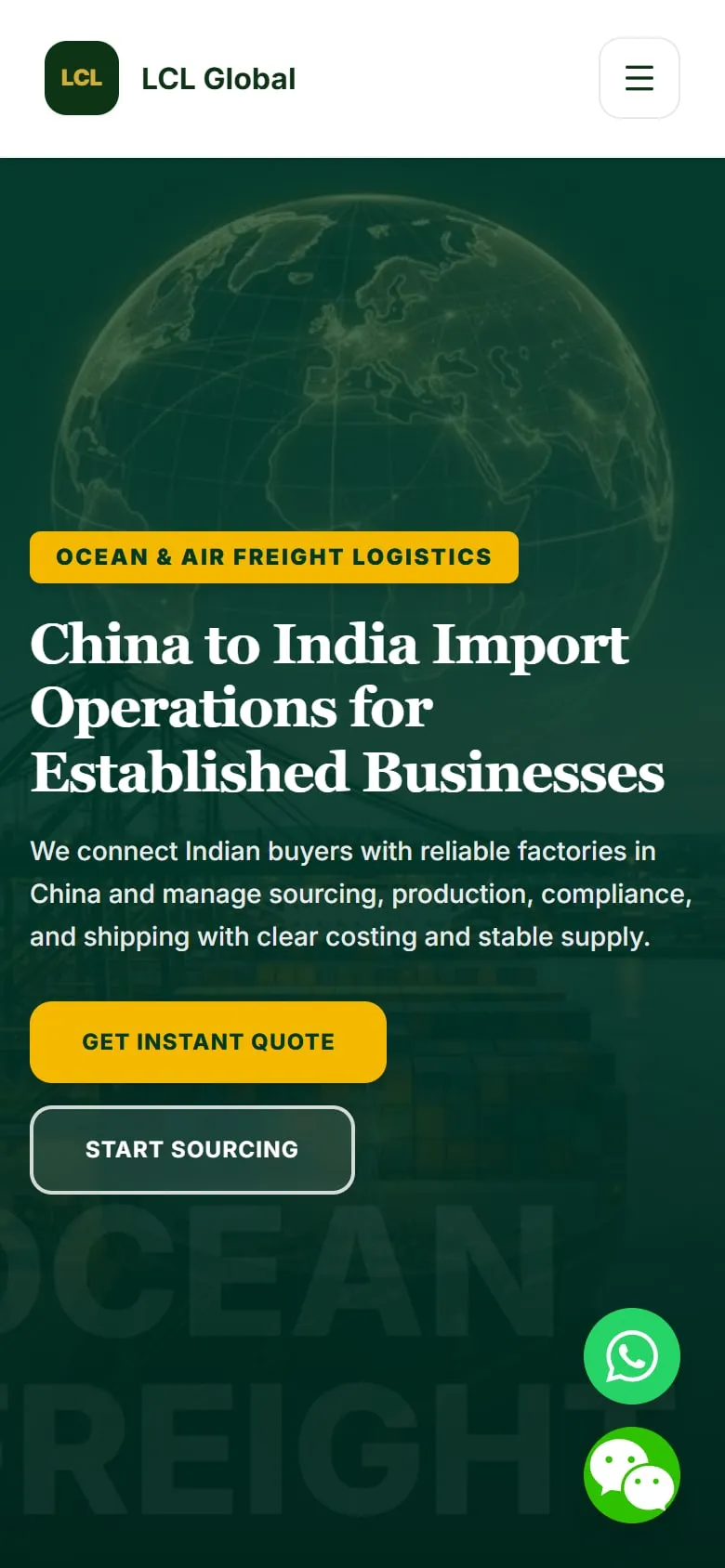
LCL Global Trading Group finds Chinese factories for Indian businesses and handles everything after that: production, compliance, freight and delivery, led by a founder with more than 23 years in trade. It works as a fully managed sourcing arm, not a consultant.
Importers have been burned by vague quotes before. The site had to earn trust with specifics, and meet each buyer wherever their order stands today.
How do you get a cautious importer to trust you before the first call?
Context
The problem.
Every quote is vague.
Most logistics sites say “contact us for pricing”. Buyers read that as a hidden cost.
Buyers arrive at different stages.
Some need a supplier. Some have cargo ready to ship. One contact form can’t serve both.
Duties are confusing.
Customs duty, surcharges and IGST stack up in ways most importers can’t work out alone.
Approach
How we played it.
Specifics earn trust.
Codes, duties, hubs and process, all on the page.
Start where the buyer is.
The first question is where your order stands today, not who you are.
Give them something to use.
A tool an importer can use without talking to anyone is the strongest pitch a site can make.
Outcome
What we built.
A landed-cost calculator.
Look up a product’s HSN code and it works out each duty (basic customs duty, the social welfare surcharge, AIDC, IGST and cess) and the cost per unit.
Six starting points.
From finding a supplier to cargo that’s ready in China, each route carries through to the enquiry form, so the team knows where to begin.
Enquiries that land where the team works.
Every enquiry arrives by email and in a shared sheet, with the buyer’s stage attached.
The China hubs, matched to products.
A guide to the hubs the team works across, from Guangzhou to Yiwu, and which one suits what you’re buying.
A blog the client runs.
Twenty articles on sourcing, duties and compliance, with an editing guide so the team publishes without us.
Outcome
Where it landed.
- Pages, from services to guides
- 28
- Articles on sourcing, duties and compliance
- 20
- Ways in, one for each stage of an order
- 6
Conclusion
What we took away.
Tools sell better than claims.
The calculator does more for trust than any paragraph about transparency.
Route the enquiry, not just the visitor.
Knowing a buyer’s stage before the call saves both sides the first twenty minutes.
Hand over the keys.
A blog the client can edit keeps the site growing after launch.
